Last 30-Day Revision Strategy for Board Exams
A practical, phase-wise revision plan to help students revise smartly, reduce stress, and perform confidently in board exams.
Board examinations play a decisive role in shaping a student’s academic future. While months of preparation are important, it is the final 30 days before the board exams that often determine the final outcome. This period is not meant for panic or last-minute cramming; instead, it should be used for systematic revision, practice, and confidence building.t.
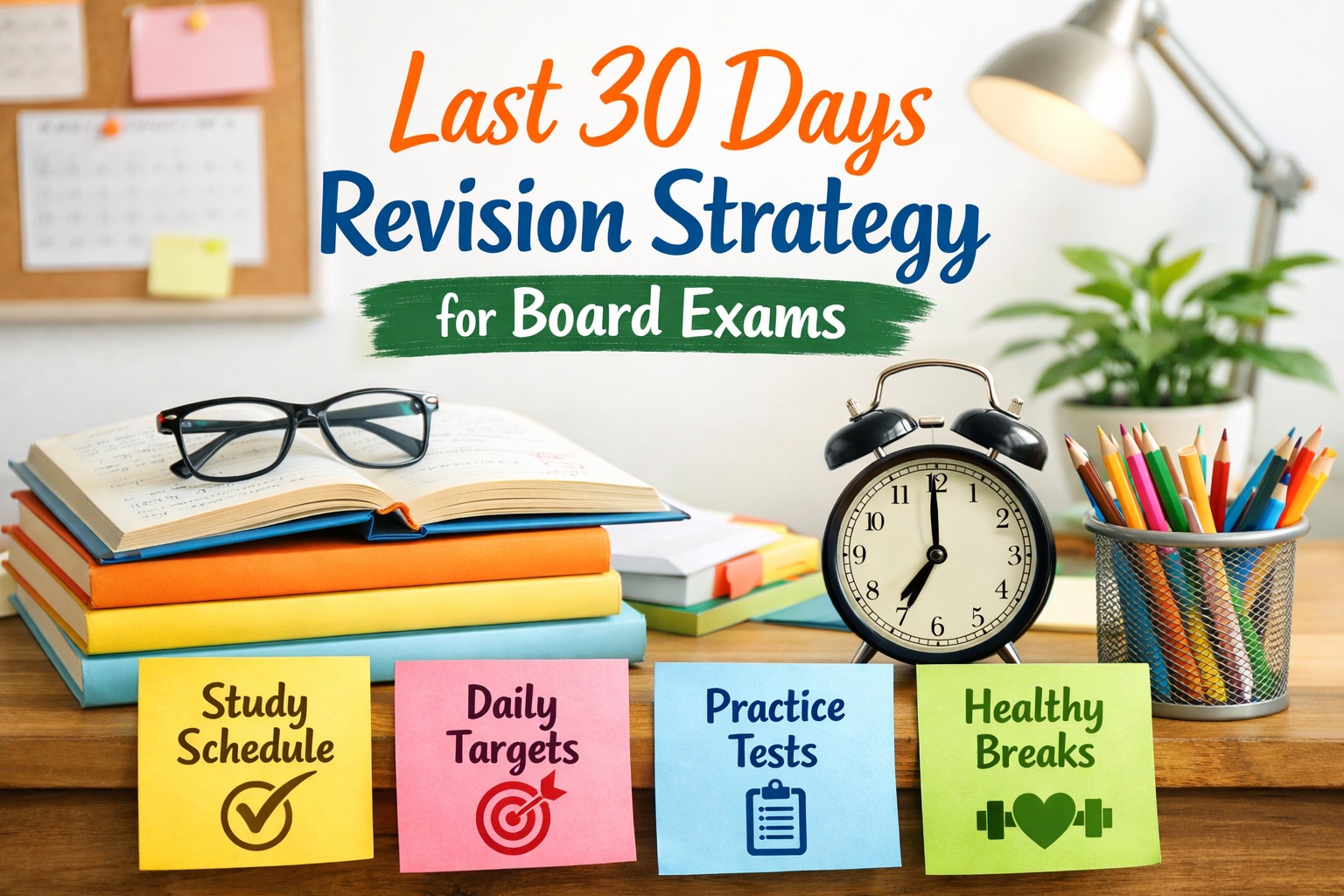
A well-structured 30-day revision strategy can help students strengthen weak areas, improve writing speed, and approach exams with clarity and calmness. This article outlines a practical, phase-wise revision plan that students can realistically follow during the last month before their board exams.
Why the Last 30 Days Are Critical for Board Exam Success
The final month before board exams is the most productive phase if used correctly. By this time, most of the syllabus has already been covered at school or coaching classes. The focus should now shift from learning new topics to revising, practicing, and refining exam techniques.
During these 30 days, students can:
- Consolidate their understanding of key concepts
- Identify and correct common mistakes
- Improve answer presentation and time management
- Reduce exam anxiety through regular practice
Students who revise strategically during this period often outperform those who study randomly without a plan.
30-Day Revision Strategy – Phase-Wise Breakdown
Phase 1: Day 1 to Day 10 – Complete Syllabus Revision
Objective: Revise the entire syllabus once in a structured manner.
In the first ten days, the goal should be to go through all subjects and chapters at least once. This phase helps refresh concepts and identify topics that require additional attention.
What Students Should Do
- Divide the syllabus subject-wise and chapter-wise
- Revise from school notes, coaching notes, and textbooks
- Focus on formulas, definitions, key points, and diagrams
- Avoid starting new reference books at this stage
Daily Study Plan
- Study 2 subjects per day
- Allocate 6 to 8 focused study hours
- Take short breaks to avoid fatigue
Important Tip: Mark difficult chapters or weak areas during revision. These will be handled in detail in the next phase.
Why the Last 30 Days Are Critical for Board Exam Success
The final month before board exams is the most productive phase if used correctly. By this time, most of the syllabus has already been covered at school or coaching classes. The focus should now shift from learning new topics to revising, practicing, and refining exam techniques.
During these 30 days, students can:
- Consolidate their understanding of key concepts
- Identify and correct common mistakes
- Improve answer presentation and time management
- Reduce exam anxiety through regular practice
Students who revise strategically during this period often outperform those who study randomly without a plan.
30-Day Revision Strategy – Phase-Wise Breakdown
Phase 1: Day 1 to Day 10 – Complete Syllabus Revision
Objective: Revise the entire syllabus once in a structured manner.
In the first ten days, the goal should be to go through all subjects and chapters at least once. This phase helps refresh concepts and identify topics that require additional attention.
What Students Should Do
- Divide the syllabus subject-wise and chapter-wise
- Revise from school notes, coaching notes, and textbooks
- Focus on formulas, definitions, key points, and diagrams
- Avoid starting new reference books at this stage
Daily Study Plan
- Study 2 subjects per day
- Allocate 6 to 8 focused study hours
- Take short breaks to avoid fatigue
Important Tip: Mark difficult chapters or weak areas during revision. These will be handled in detail in the next phase.
Phase 3: Day 21 to Day 27 – Full-Length Mock Tests
Objective: Build exam confidence and improve speed and accuracy.
In this phase, students should simulate the real exam environment. Full-length mock tests help students understand how well they can manage time and pressure.
What Students Should Do
- Attempt full syllabus mock papers
- Follow exact exam timing and rules
- Avoid distractions such as mobile phones
- Evaluate answers honestly after each test
Benefits of Mock Tests
- Improves writing speed
- Builds exam temperament
- Reduces fear and nervousness
- Highlights last-minute improvement areas
Students should not feel discouraged by low scores in mock tests. The purpose of these tests is improvement, not judgment.
Phase 4: Day 28 to Day 30 – Final Revision and Mental Preparation
Objective: Keep the mind calm and memory sharp.
The last three days should be light, positive, and stress-free. Heavy studying at this stage can lead to confusion and anxiety.
What Students Should Do
- Revise formulas, key points, and summaries
- Go through short notes and highlighted sections
- Avoid attempting new mock tests
- Sleep adequately and maintain a healthy routine
A calm and confident mindset during these final days plays a major role in exam performance.
Subject-Wise Revision Tips for the Last 30 Days
Mathematics
- Revise formulas daily
- Practice important numericals repeatedly
- Focus on accuracy rather than speed
Science
- Revise diagrams, definitions, and numericals
- Focus on frequently asked questions
- Practice structured, step-wise answers
Theory Subjects
- Use headings and subheadings in answers
- Write clear, concise points
- Include keywords and examples wherever applicable
Common Mistakes Students Should Avoid
During the last 30 days, students should strictly avoid:
- Starting entirely new topics
- Comparing preparation with other students
- Compromising on sleep and health
- Excessive use of mobile phones and social media
- Ignoring weak subjects due to fear
Discipline and consistency are more important than studying for long hours.
How Pawar Academy Supports Students During Final Revision
Pawar Academy follows a structured and student-centric approach during the final revision phase. Students receive:
- Planned revision schedules
- Regular tests with performance analysis
- Personal doubt-solving sessions
- Exam-oriented answer writing guidance
- Continuous motivation and mentoring
This systematic support ensures that students are well-prepared, confident, and exam-ready.
Final Thoughts
The last 30 days before board exams can transform a student’s final result when used wisely. Success during this period depends not on studying more, but on revising smartly, practicing regularly, and staying calm.
With a clear plan, disciplined routine, and positive mindset, every student can perform to their full potential in board exams.
Join Pawar Academy and revise smartly for confident exam performance.